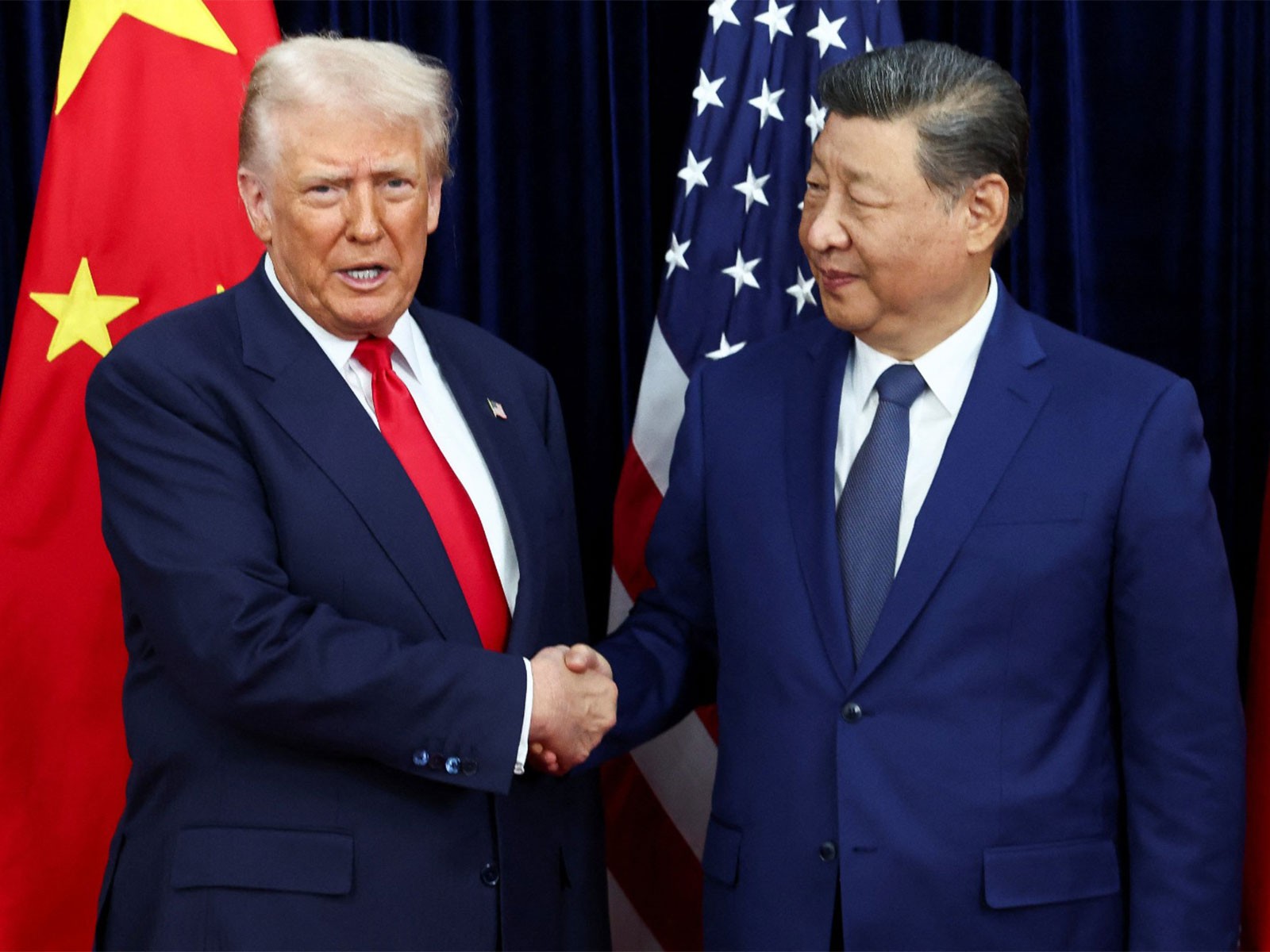
The agenda for the US-China summit is gradually emerging ahead of April.
Feb 12, 2026
Washington [US], February 12: The US and China are reportedly close to extending their trade truce for up to another year, amid expectations that President Donald Trump will meet with President Xi Jinping in Beijing in early April.
The agreement to de-escalate trade tensions , reached in October 2025 after a bilateral meeting between Trump and Xi in Busan (South Korea), helped lift a series of previously imposed tariffs and export restrictions.
Since the agreement came into effect, China has resumed importing U.S. soybeans - a commodity of significant political importance in Washington.
According to sources, extending the current agreement is seen as a practical step to create a stable foundation for the upcoming summit to focus on short-term economic outcomes, including new purchasing commitments from China, according to the South China Morning Post .
Trump is reportedly pushing for concrete achievements ahead of the November midterm elections, amid pressure on Republicans to maintain their majority in Congress. Following a nearly two-hour phone call with Xi Jinping last week, Trump said China was considering increasing its purchases of U.S. soybeans.
Four sources familiar with the matter said that Trump's visit to China could begin on March 31 and last about three days, with bilateral meetings expected to take place in the first week of April. However, the schedule is still being considered by both sides, as China wants to arrange it to coincide with the Qingming Festival (April 5).
Although there has been no official confirmation from the US or China, many sources suggest that the timeframe in early April is likely to be finalized.
A source familiar with the plan said that no American business leaders have yet been invited to join the delegation, as the Trump administration wants to avoid giving the impression of encouraging investment in China.
However, observers believe that agreements in the automotive and energy sectors may be announced, while the recent deal involving TikTok is seen as setting a precedent for other sectors.
Ahead of the summit, both sides made certain concessions. Following the Busan meeting, the US eased some restrictions on the export of advanced semiconductors to China, in exchange for Beijing adjusting its policies on critical minerals and rare earth elements.
On February 11, Chinese Ambassador to the US Xie Feng stated that bilateral relations are achieving "overall dynamic stability," despite ongoing ups and downs.
The official also called for expanded cooperation in agriculture, energy, and the economy, while promoting new fields such as biomedicine and artificial intelligence. He also emphasized that both sides need to avoid viewing each other through a "confrontational lens."
However, Mr. Xie reiterated that Taiwan is a "red line that must not be crossed," urging the US to abide by the "one China" principle and the three bilateral joint communiques.
A source said the Taiwan issue remains a potential flashpoint that could affect the negotiation process, especially in light of recent US increased arms sales to the island.
Prior to the planned visit, a group of senior US Treasury officials traveled to Beijing last week to "strengthen communication channels." US Treasury Secretary Scott Bessent subsequently described the relationship between the two countries as "stable but competitive," emphasizing Washington's goal of "fair competition and risk mitigation, not decoupling."
Mr. Bessent also stated that China needs to rebalance its economy and address its large trade surplus with the United States. He is expected to meet with Chinese Vice Premier He Lifeng soon to prepare the agenda for the summit.
Source: Thanh Nien Newspaper